Home » Blog » Different Types of Welding (and When to Use Each)
Different Types of Welding (and When to Use Each)
Posted by Astro Machine Works on
Metals are among the most durable and versatile materials used in manufacturing. Forming and shaping them into precision components requires not only advanced machining, but also the right fabrication and welding services to ensure structural integrity and performance. Welding allows a fabrication welder to fuse metal components using concentrated heat, creating strong, permanent bonds that withstand stress and environmental factors.
Over the years, engineers have developed multiple welding processes suited to different materials, geometries, and use cases. The most common methods (MIG, TIG, and Stick welding) remain foundational in modern welding services, from heavy industrial projects to precision aerospace applications.
Below, we’ll explore these three primary welding methods and their real-world applications, followed by a look at other specialized processes used in advanced fabrication.
MIG WELDING
Metal inert gas (MIG) welding is a form of manual arc welding for heavy metals, alternately known as gas metal arc welding.
WHAT IS MIG WELDING?
MIG welding is a metal-bonding and metal-shaping process that sends an electrode through a tool gun and applies it to corresponding metal surfaces. To prevent contamination, the welding gun employs a protective gas that shields the weld area. The MIG process is an easy and accessible welding process for garage-based metal workers and hobbyists.
The process works on metals that range from 24-gauge to half an inch thick. MIG welding is popular among metal-working novices because it is a more straightforward technique to learn and master. The MIG wire does not protect metal services from rust or corrosion. Therefore, clean and brush down bare metal parts before a MIG application. To ensure a pure flow of the electrical wire, only use clean metal in the process.
MIG WELDING APPLICATIONS
MIG welding is one of the methods most commonly used in heavy-duty arc welding projects. Some of the metal components that make up your city’s sewage or water system are the result of MIG welding. The process is standard for pipe welds. As such, the water you rely on for drinking, cooking and sanitation comes through pipes that would not be possible without MIG welding applications.
Due to the heavy-duty nature of the method, MIG welding is a typical technique in hard facing, which entails welding rough materials onto base metals. You have MIG welding to thank for some of the parts you see on tractors, cranes and other types of rolling stock.
MIG welding has also been essential in the preparation and assembly of the nation’s railroad tracks. Thanks to the method’s ability to join thick metal pieces together with unbreakable strength, MIG welding applications have been responsible for railways and public streetcar tracks that rarely require maintenance. As such, MIG welding is a chief facilitator of transportation and commerce.
The auto industry also relies on MIG welding. At the factories where workers prepare and assemble auto parts into finished vehicles, they use MIG welding applications for the heavier metals and equipment. Additionally, MIG welding is responsible for making the factory equipment you see along production lines. MIG welding is also a popular method at auto repair shops. These applications of MIG welding play a vital role in many aspects in all of our lives.
TIG WELDING
Tungsten inert gas (TIG) welding is a manual arc welding process for heavy metals, alternately known as tungsten gas arc welding.
WHAT IS TIG WELDING?
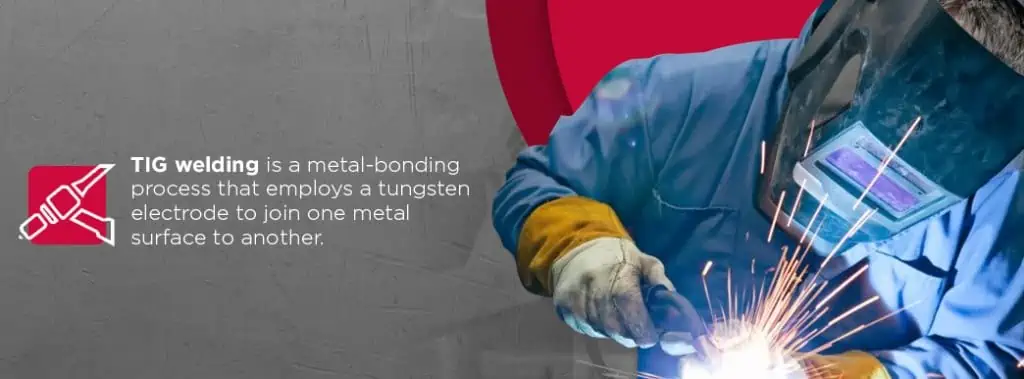
TIG welding is a metal-bonding process that employs a tungsten electrode to join one metal surface to another. During the process, argon or helium gas forms a protective shield on the applied surfaces against oxidation and other air-bound contaminants. Applications that use helium gas are also called heliarc welds. Most TIG applications rely on a middle metal. Exceptions to the rule are called autogenous welds.
The essential difference between MIG and TIG welding is that the former relies on an ongoing wire feed, whereas the latter relies on welding rods that you direct into the weld puddle.
TIG WELDING APPLICATIONS
TIG welding plays a vital role in the automotive industry, where the process is effective at bonding metal parts together for the construction of cars, vans, trucks and SUVs. The tungsten electrodes work well in the factories where workers assemble engine parts from individual pieces of metal, as well as in the plants where auto-body parts get prepared for the assembly lines.
TIG welding is also essential in the construction industry, where the equipment gets transported to worksites and used in the preparation of parts for buildings and public monuments. Many of the buildings you see along the streets and thoroughfares of your community have been the work of construction crews that rely heavily on TIG welding.
The shipping industry also employs TIG welding. The process makes it easier for shipbuilders to join shaped metal parts together for ships like aircraft carriers or cruise liners. If you have ridden a passenger ship or sailed overseas while serving in the U.S. Navy, tungsten electrodes have likely welded the body of each ship in full or in part.
TIG welding is furthermore crucial in the aerospace industry, where the process brings together the parts that comprise NASA’s rocket ships and space shuttles.
Learn more about Astro Machine Works unique manufacturing service offerings, including CNC machining, reverse engineering, and more.
Stick welding is a form of hand-driven arc welding used on a range of metals. The process is alternately known as shielded metal arc welding and flux-shielded arc welding.
WHAT IS STICK WELDING?
Stick welding is a metal-bonding method in which a flux-covered consumable electrode bonds two metal surfaces together. During the stick-welding process, a direct or alternating current forms between the electrode and the adjoining metal surfaces. Vapors that result from the fading electrodes generate the shielding gas. People commonly use the process to weld steel and iron, as well as copper, nickel and aluminum.
STICK WELDING APPLICATIONS
Stick welding can help workers complete tasks large and small in virtually any location. For outbound applications, the process is convenient because the equipment required is portable and easy to transport for on-call repair tasks. Therefore, stick welding often comes into play in otherwise hard-to-reach locations and remote public buildings.
Stick welding is also common at outdoor construction sites, where the process makes it easy for work crews to assemble and modify metal parts on the spot. The flux-covered electrodes are wind-resistant, which makes the process convenient in various environments. When a disaster strikes, stick welding is often the method used to repair damaged metal fixtures.
In remote settings, stick welding is one of the most convenient types of arc welding. When workers assemble temporary structures for county fairs and carnivals, stick welding can strengthen and fortify the support beams of tents and fences. For communities that live off the grid, stick welding is one of the most reliable methods for metal repair and construction.
The portability and ease of stick welding have also made it one of the preferred methods among hobbyists and independent craftspeople. Since the approach works with a broad variety of metals, jewelry makers sometimes use stick welding.
Why Welding Process Selection Matters
Pick the wrong process and you’ll fight distortion, porosity, lack of fusion, or excessive post-processing. Pick the right one and you’ll hit spec the first time with fewer setups and lower cost. The optimal choice depends on:
Best for: Field work, maintenance, thick sections, windy/outdoor conditions.
Why choose it: Portable, tolerant of less-than-pristine environments; broad rod choices (E6010, E7018, etc.).
Watch-outs: Higher spatter and slag; more post-weld cleanup; slower than wire processes.
Typical applications: Structural repairs, on-site erection, heavy equipment.
Productivity Boosters for Heavy Fabrication
Flux-Cored / FCAW
Best for: Carbon steels; medium-to-heavy sections; high deposition.
Why choose it: Out-welds solid-wire MIG on a heavy plate; excellent vertical-up with proper flux system.
Watch-outs: Flux handling and fume control; parameter windows are tighter than GMAW.
Use cases: Weldments, frames, crane/rigging structures, hardfacing.
Submerged Arc / SAW
Best for: Very heavy sections, long linear seams.
Why choose it: Extremely high deposition under granular flux with outstanding bead quality and low dilution.
Watch-outs: Requires line-of-sight access and dedicated setups/fixtures.
Use cases: Pressure-retaining shells, beams, large ring/pipe seams.
Sheet Metal & Fastening-Heavy Assemblies
Resistance Spot & Projection Welding (RSW/PW)
Best for: Low-carbon steel sheet, nut/stud attachment, cross-wire grids.
Why choose it: Fast, repeatable, minimal consumables; great for high-volume cells.
Watch-outs: Tight control of squeeze force, timing, and electrode condition; material stack-up must be consistent.
Use cases: Enclosures, brackets with PEMs or projections, automotive-style subassemblies.
Cutting/Repair & Specialty Cases
Oxy-Fuel (OAW/OFC)
Best for: Field fit-ups, preheat/interpass heat control, brazing, legacy repairs.
Why choose it: Portable flame source that supports cutting, heating, and joining.
Watch-outs: Larger heat-affected zones; not ideal for modern thin stainless/aluminum work.
Plasma Arc & Other Specialized Processes
Best for: Precision keyholes and high-temp applications (process-dependent).
Note: Often reserved for niche requirements or automated cells.
Design Tips To Make Welding Go Right the First Time
Specify joint preps (bevel, land, root opening) aligned to process and thickness.
Call out acceptance criteria (visual, fillet size, full/partial penetration, NDE if required).
Control heat input for distortion-sensitive parts: staggered welds, fixturing, chill bars, sequenced passes.
Match filler to service: Strength class, corrosion requirements, impact toughness, ferrite balance for stainless.
Surface prep matters: Remove oxides/oils; keep aluminum oxide and titanium scrupulously clean for TIG.
How Astro Machine Works Supports Production-Grade Welds
As part of our end-to-end fabrication welding services, Astro integrates certified welding with precision machining and assembly to collapse lead time and risk.
Processes: MIG/GMAW, TIG/GTAW (including orbital), Stick/SMAW; resistance and brazing support as project needs dictate.
Metals: Carbon/stainless steels, aluminum (and other alloys on review).
Quality: AWS-certified welders, ISO 9001:2015 & AS9100D quality systems with in-process inspection, CMM verification, and documented WPS/PQR where required.
Upstream/Downstream: 5-axis machining, CNC milling/turning, fixturing, reverse engineering, assembly, and turnkey testing—so your welded components arrive “ready for install.”
If you need a fabrication welder who can advise on process trade-offs (and then execute with production discipline) our team can help you choose the most economical path without compromising code or performance.
Ready to build?
Bring us your print (or concept) and we’ll recommend the right welding process, create/qualify the procedure, and deliver repeatable quality as part of full-stack welding services and fabrication.